



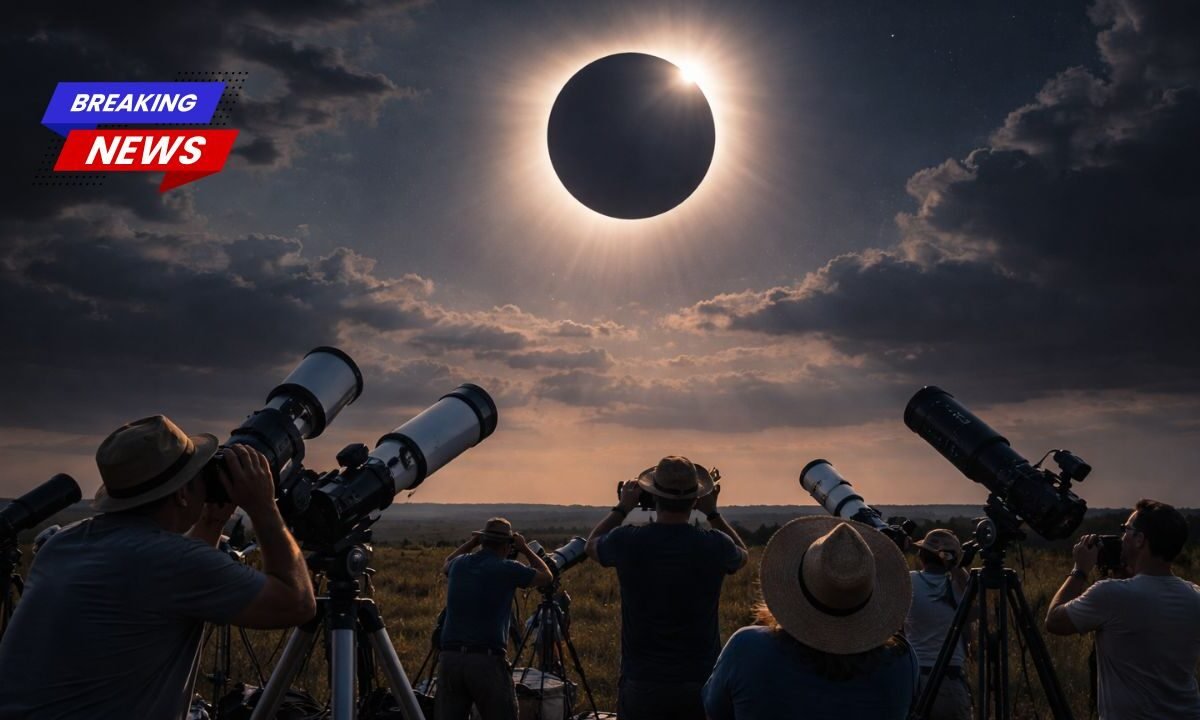
A once-in-a-lifetime celestial event is officially on the calendar. Astronomers have now confirmed the date of the century’s longest total solar eclipse, an extraordinary astronomical phenomenon that will temporarily transform bright daytime skies into deep twilight. This rare event is expected to draw global attention from scientists, skywatchers, photographers, and space enthusiasts eager to witness one of the most dramatic displays in the natural world.
The upcoming longest total solar eclipse of the 21st century is projected to occur on July 16, 2186, and it will last an astonishing 7 minutes and 29 seconds at its maximum point of totality. While that date may seem far in the future, astronomers have already calculated its path and duration with remarkable precision using orbital mechanics and advanced eclipse modeling.
This confirmed date of the longest solar eclipse of the century highlights the predictable yet awe-inspiring nature of celestial motion. Let us explore why this eclipse is so special, how scientists determined its duration, and what makes a solar eclipse last longer than usual.
What Makes This Solar Eclipse the Longest of the Century?
Understanding Total Solar Eclipse Duration
A total solar eclipse occurs when the Moon passes directly between the Earth and the Sun, completely blocking the Sun’s visible surface for observers located within the path of totality. During this brief period, the sky darkens dramatically, temperatures may drop slightly, and the Sun’s outer atmosphere, known as the corona, becomes visible.
The length of totality depends on several astronomical factors:
- The distance between the Earth and the Moon
- The Earth’s distance from the Sun
- The alignment angle of the three celestial bodies
- The speed of the Moon’s shadow across Earth’s surface
On July 16, 2186, all these variables align in a way that produces the maximum theoretical duration of total solar eclipse possible in this century.
Why 2186 Produces a Record-Breaking Eclipse
In 2186, the Moon will be relatively close to Earth (near perigee), appearing slightly larger in the sky. At the same time, Earth will be near aphelion, its farthest point from the Sun, making the Sun appear slightly smaller. This combination allows the Moon to cover the Sun completely for a longer period.
Additionally, the eclipse path will cross near Earth’s equatorial region, where the rotational speed of the planet helps extend the duration of totality. The geometry of this alignment is what allows the eclipse to reach an impressive 7 minutes and 29 seconds.
Key Details of the Century’s Longest Solar Eclipse
Below is a clear summary of the confirmed astronomical data for this historic event:
| Feature | Confirmed Detail |
|---|---|
| Eclipse Type | Total Solar Eclipse |
| Date | July 16, 2186 |
| Maximum Duration | 7 minutes 29 seconds |
| Region of Maximum Totality | Northern South America |
| Century Record | Longest total eclipse of the 21st century |
| Visibility | Partial worldwide, total in path of totality |
Although it is still more than 160 years away, astronomers have mapped its projected path across parts of South America and surrounding regions.
How Astronomers Confirm Eclipse Dates So Far in Advance
Predicting Solar Eclipses with Precision
Modern astronomy allows scientists to predict solar eclipses centuries into the future. This is possible because the orbital paths of Earth and the Moon follow well-understood gravitational laws described by classical physics and refined through space-age observations.
Using detailed computer simulations and long-term eclipse cycles such as the Saros cycle (approximately 18 years and 11 days), researchers can determine not only when an eclipse will occur but also its duration, intensity, and geographic visibility.
The Role of Orbital Mechanics
The Moon’s orbit is not perfectly circular, and neither is Earth’s orbit around the Sun. These subtle variations create differences in eclipse timing and length. By accounting for these orbital variations, astronomers can calculate eclipse events centuries ahead with remarkable accuracy.
The confirmation of the longest solar eclipse of the century demonstrates the predictive power of astronomical science and the reliability of orbital modeling.
Why Solar Eclipses Do Not All Last the Same Length
Factors That Influence Eclipse Duration
Not every total solar eclipse is equally long. Some last only a few seconds, while others extend beyond seven minutes. The maximum theoretical duration for any total solar eclipse is approximately 7 minutes and 32 seconds. The 2186 eclipse comes very close to this upper limit.
Several key factors determine duration:
- A larger apparent Moon size
- A smaller apparent Sun size
- A slower-moving shadow across Earth
- Observers positioned near the center of the eclipse path
When these conditions combine optimally, the result is an unusually long total solar eclipse event.
Comparison with Recent Long Eclipses
For perspective, the total solar eclipse of July 22, 2009 lasted up to 6 minutes and 39 seconds in parts of Asia, making it one of the longest of recent times. However, it still falls short of the 2186 record.
The confirmed July 16, 2186 eclipse stands out as the longest total solar eclipse of this century, surpassing all others in duration.
What Happens When Daylight Turns to Night
The Experience of Totality
When totality begins, the change is sudden and dramatic. The sky darkens rapidly, stars may become visible, and animals often behave as though evening has arrived. The temperature can drop by several degrees, and a 360-degree twilight glow appears along the horizon.
This transformation from day to night is one of the most powerful natural experiences available without leaving Earth. The Sun’s corona, typically hidden by its brightness, forms a glowing halo around the darkened Moon.
Scientific Opportunities During Long Eclipses
Longer eclipses provide more time for scientific observations. Researchers can study:
- Solar corona structure
- Magnetic field activity
- Plasma dynamics
- Atmospheric response on Earth
The extended 7-minute totality in 2186 will offer valuable opportunities for solar physics research, even if that research lies in the distant future.
Global Interest in Rare Solar Events
Although 2186 may seem far away, the confirmation of this century’s longest solar eclipse has already generated interest among astronomers and eclipse historians. Rare astronomical events often become part of long-term scientific planning and historical record.
Eclipses connect generations. Past civilizations documented them with awe and sometimes fear. Today, we understand the science behind them, yet the emotional impact remains powerful.
The anticipation surrounding the confirmed date of the longest total solar eclipse of the century reflects humanity’s ongoing fascination with the cosmos.
Conclusion
The official confirmation of July 16, 2186, as the date of the century’s longest total solar eclipse marks a significant milestone in astronomical forecasting. With a maximum duration of 7 minutes and 29 seconds, this eclipse will push the limits of totality and provide one of the most extraordinary sky events of the 21st century.
Although few people alive today will witness it, the event symbolizes the precision of modern astronomy and the timeless beauty of celestial mechanics. When daylight turns to night during this historic eclipse, it will remind future generations of our deep connection to the rhythms of the solar system.
The longest total solar eclipse of the century is not just a date on a calendar—it is a testament to the predictable elegance of the universe.